Accessibility links
  • Skip to main content
News Icon NEWS FILTER
All News Scams & Phishing Your Security Mobile Security Identity Theft Corporate Security Security Education Videos
Search Icon SEARCH
 

Email Icon SUBSCRIBE TO WEEKLY NEWSLETTER
Your Digital Life May Not Be Your Own
Facebook   X   LinkedIn   Email

Your Digital Life May Not Be Your Own

May 5, 2026

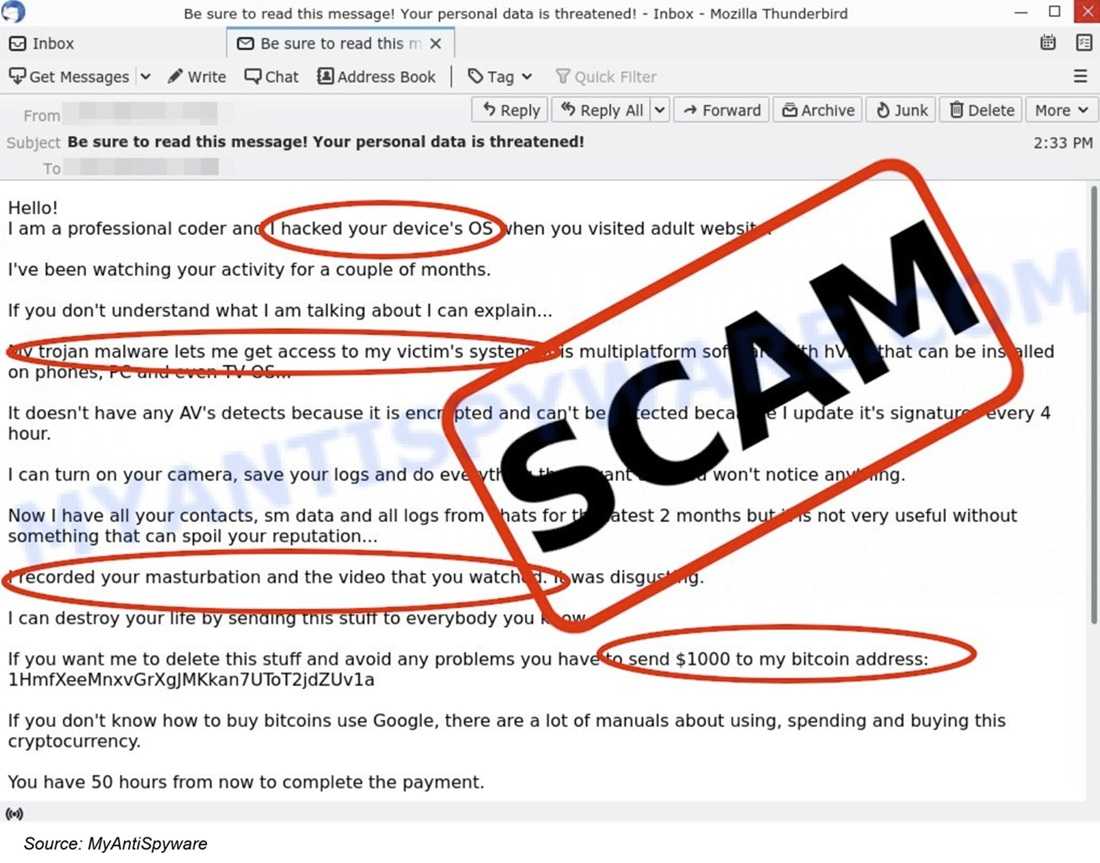
We know a lot of information about us likely available on the Dark Web. If you’re online at all, it’s difficult to avoid. However, a growing email scam is making the rounds that tries to convince people their entire digital life has been compromised. The message often begins with a bold claim that the sender already has access to your passwords, photos, financial information, and files; essentially anything that is on your computer or smart device.

Keeping it real

To make it more realistic, the scammer may include an old password in the message to make the threat feel real. After all, many passwords are stolen all the time. They then demand quick payment, usually in cryptocurrency, to prevent your information from being posted online or sold on the dark web.

In reality, these scammers usually do not have full access to your device. They just want you to think they do. Instead, they rely on information gathered from older data breaches where passwords or email addresses were leaked years ago. By inserting one of those old passwords into the message, the criminal hopes you’ll believe they truly hacked your device and panic into paying.

Pressure to act fast

Like many scams, urgency is part of the trick. The email may claim you only have 24 or 48 hours before your data is exposed. Some messages even say the hacker recorded you through your webcam or installed spyware on your device. That really would be creepy, but it’s not likely to be true.

The goal is simple: To scare you into sending money before you have time to question the threat.

What you should do instead

If you receive one of these messages, experts say the safest response is not to engage at all.

Take these steps instead:

  • Do not reply or pay the ransom. Paying only encourages more of the same behaviors.
  • Delete the message and mark it as spam. If you have the option to block the sender, that’s not a bad idea.
  • Change any passwords mentioned in the email, especially if you still use them. If they have them, someone else may too, so just take the time to change them.
  • Use strong, unique passwords for every account.
  • Turn on two-factor authentication whenever possible.

Don’t let fear do the work for them. Extortion scams succeed because they play on fear and embarrassment. The message may sound convincing, but in most cases it’s simply a bluff designed to shake money loose. Taking a moment to pause, verify, and protect your accounts can keep scammers from turning an empty threat into a costly mistake.


Scattered Spider’s Web Of Lies, Deception And Ransomware

Your Security

Scattered Spider’s Web Of Lies, Deception And Ransomware

Warnings from the FBI and CISA came in loud and clear recently…Scattered Spider’s cyberattacks are more hazardous and crippling than ever before. Their high-profile, financially motivated attacks rely on social engineering for data theft, extortion, and ransomware attacks. And when both security agencies release a joint advisory warning to us about this threat group, it’s smart to listen. These threat actors made headlines for crippling financial attacks against several large organizations recently and they've increased the stakes playing their games. READ FULL STORY

Do You Get My Vibe? Claude AI a Tool of Crime

Your Security

Do You Get My Vibe? Claude AI a Tool of Crime

Anthropic revealed that its Claude AI models—especially Claude Code—were hijacked by criminals to carry out what they describe as an “unprecedented” cybercrime spree. Rather than just using AI as an assistant, attackers used Claude end-to-end: zeroing in on weak spots, stealing data, crafting malware, and then demanding ransoms. The operation reportedly touched at least 17 organizations, covering healthcare, emergency services, government, and others.  READ FULL STORY

FBI Warns Medusa is Trying to Snake Her Way Into Your Network

Your Security

FBI Warns Medusa is Trying to Snake Her Way Into Your Network

The Federal Bureau of Investigation (FBI) and the Cybersecurity and Infrastructure Security Agency (CISA) recently issued a warning about a ransomware-as-a-service variant that has been on the attack since December. The Medusa ransomware, a sophisticated cyber threat that has targeted over 300 victims across critical infrastructure sectors. These include, healthcare, education, and manufacturing. The group employs tactics such as phishing campaigns and exploiting unpatched software vulnerabilities to gain unauthorized access to systems. READ FULL STORY

IC3 Issues Alert About a Cybercrime Group Recruiting Kids

Your Security

IC3 Issues Alert About a Cybercrime Group Recruiting Kids

The FBI's IC3 has just sounded the alarm about a growing online criminal network called The Com (short for "The Community") and it's not your average hacker crew. This sprawling, international ecosystem includes thousands of members, many of them minors who are wrapped up in cybercrime, extortion, swatting, SIM swapping, ransomware, and even child sexual abuse content. What’s worse? They recruit young people, some as young as 11 through gaming sites and social media. READ FULL STORY

Email Scams Threaten Extortion And Blackmail

Scams & Phishing

Email Scams Threaten Extortion And Blackmail

An uptick in email scams has cybersecurity professionals concerned, and for good reason. Symantec researchers found that in the first five months of 2019, they prevented almost 300 million extortion email attacks from going forward. Just some of those discovered include blackmail, sextortion, bombs, hit men, and malware threats. The researchers also determined the average cost of paying demands over a 30 day period was $1.2 million in 243 Bitcoin transactions. READ FULL STORY


Close
Fraud News & Alerts!

Keep up with the latest cyber security news through our weekly Fraud News & Alerts updates. Each week you will receive an email containing the latest cyber security news, tips and breach notifications.


You're all set!

You will receive your first official security update email within the next week.

A welcome email has also just been sent to you. If you do not receive this email within the next few minutes, please check your Junk box or spam filter to confirm our emails are not being blocked.


Help  
Enter any word or words you like.        

The email newsletter will arrive from news@stickleyonsecurity.com


Loading
Please wait...