Accessibility links
  • Skip to main content
News Icon NEWS FILTER
All News Scams & Phishing Your Security Mobile Security Identity Theft Corporate Security Security Education Videos
Search Icon SEARCH
 

Email Icon SUBSCRIBE TO WEEKLY NEWSLETTER
Text Scam Frenzy Explodes Over 300 Percent as Scammers Target Financial Institutions
Facebook   X   LinkedIn   Email

Text Scam Frenzy Explodes Over 300 Percent as Scammers Target Financial Institutions

March 16, 2026

Cyber crooks are cranking up the heat in the digital world with a tidal wave of phishing scams. These impersonate financial institutions, according to a cybersecurity report from AhnLab. It reported that text-message attacks with the cybercriminals posing as financial institutions surged an eye-popping 343.6% between October and December of 2025, making them the most common type of phishing texts detected in that period.

These schemes cloak themselves in familiar language like “card issuance completed” or bogus “transaction alerts,” nudging victims to click on deceptive links or call fake customer service numbers. Once hooked, users risk exposing login credentials, personal data, and even one-time passcodes to fraudsters. Bottom line—bad actors are using urgency and fear to reel in clicks. 
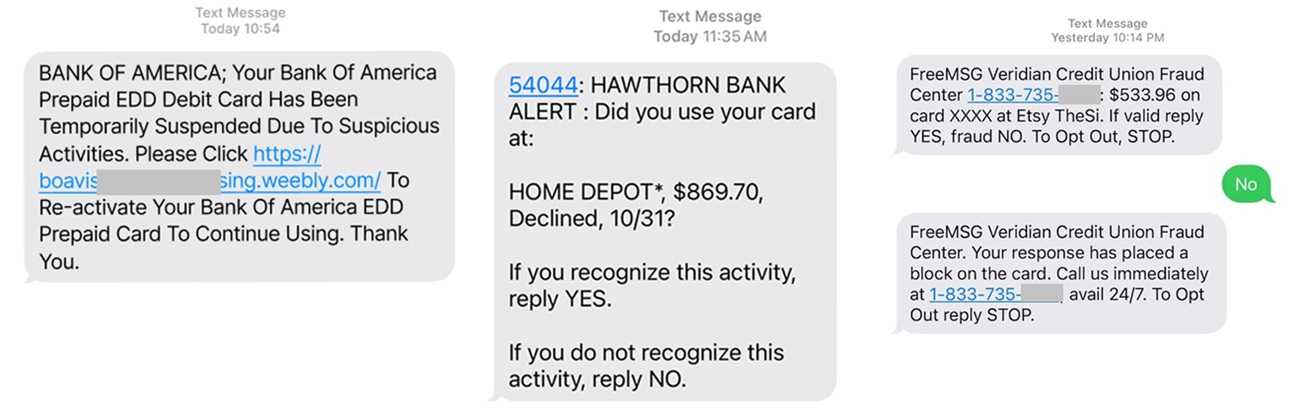
Even more alarming, the data also shows that financial impersonation now accounts for almost half of all reported phishing texts, dwarfing scams that spoof government agencies, job offers, delivery notices, and even messaging platforms. Almost every lure includes a URL designed to whisk victims away to a convincing but fraudulent site. But that doesn’t surprise anyone.

Experts warn that as phishing evolves, attackers are playing psychological tricks, not using sophisticated technologies. The simple act of clicking can deliver credentials straight into scammers’ hands.

Cybersecurity professionals still urge mobile users to treat unexpected texts with skepticism, avoid clicking on links from unknown senders, and rely on official apps or direct contact with banks to verify anything that feels off. Replying to a suspicious text or email likely will send you right back to the attackers.


Money Mule Scams Are More Common Than You Would Expect

Education

Money Mule Scams Are More Common Than You Would Expect

A money mule scam is when someone sends money to you and asks you to send a portion of it to someone else. They often ask you to use gift cards or wire transfers. The money they are providing you is likely stolen. Drug trafficking and human tracking are also common sources of the money, and they're lying about the reason they need you to send it. The relationship, job, prize or other reason they use is not real and they are only using you to launder money.  READ FULL STORY

Simple Habits That Make You a Tougher Target for Cybercrooks

Your Security

Simple Habits That Make You a Tougher Target for Cybercrooks

It’s already well into the new year and a fresh year usually brings fresh goals—exercise more, spend less, maybe try a new hobby. But one resolution that deserves a permanent spot on everyone’s list is tightening up your personal cybersecurity. Cyberthreats don’t take holidays, and scammers aren’t slowing down. In fact, they’re getting bolder, trickier, and faster at finding new ways to get into your accounts and steal your money or data. READ FULL STORY

Account Takeover Fraud Steals Your Identity, Money, And More

Identity Theft

Account Takeover Fraud Steals Your Identity, Money, And More

With a significant swell in the number of those working from home, come the most historic levels of hacking the world has ever seen. Account takeover (ATO) fraud attacks have been growing yearly, accounting for much of the identity fraud-based financial losses to consumers and businesses. ATO fraud can lead to empty bank accounts and damaged reputations, and those recovering from an attack find it’s an expensive, time consuming, and frustrating task. READ FULL STORY

Has Your Account Been Compromised? Five Cyber Smart Tips Everyone Can Use

Your Security

Has Your Account Been Compromised? Five Cyber Smart Tips Everyone Can Use

The transition to living life through our devices has become very real for scores of people and businesses. By now, the coronavirus has changed our lives in ways we never expected. This transition includes doing most things from home. Unfortunately, adapting to online life also gives bad actor’s a cornucopia of targets to exploit. There are proactive steps to take when you suspect an account may be compromised, including ways to help keep it from happening to begin with. READ FULL STORY

FBI Warns of Surge in Account Takeover Scams Targeting Everyone

Scams & Phishing

FBI Warns of Surge in Account Takeover Scams Targeting Everyone

The FBI’s Internet Crime Complaint Center issued an alert in about sophisticated account takeover schemes that are draining victims’ financial accounts, including investment portfolio accounts. And it’s not a slow-moving scam either. It’s moving at an alarming rate, and everyone should take care not to fall victim. Cybercriminals are exploiting vulnerabilities in online accounts to steal funds, with losses reaching millions of dollars and are becoming more difficult to detect. READ FULL STORY


Close
Fraud News & Alerts!

Keep up with the latest cyber security news through our weekly Fraud News & Alerts updates. Each week you will receive an email containing the latest cyber security news, tips and breach notifications.


You're all set!

You will receive your first official security update email within the next week.

A welcome email has also just been sent to you. If you do not receive this email within the next few minutes, please check your Junk box or spam filter to confirm our emails are not being blocked.


Help  
Enter any word or words you like.        

The email newsletter will arrive from news@stickleyonsecurity.com


Loading
Please wait...