Accessibility links
  • Skip to main content
News Icon NEWS FILTER
All News Scams & Phishing Your Security Mobile Security Identity Theft Corporate Security Security Education Videos
Search Icon SEARCH
 

Email Icon SUBSCRIBE TO WEEKLY NEWSLETTER
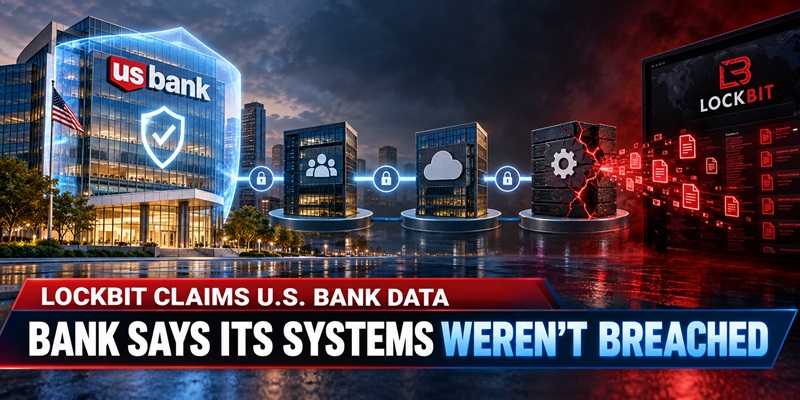
LockBit Threatening to Leak U.S. Bank Customer Data. U.S. Bank Claims They Don’t Have Any
Facebook   X   LinkedIn   Email

LockBit Threatening to Leak U.S. Bank Customer Data. U.S. Bank Claims They Don’t Have Any

October 11, 2026

If you hear that a bank has been hit by ransomware, you probably imagine hackers breaking into the bank's computer systems and stealing customer information. That isn’t how it always happens and lately, it seems it’s the rare case. This story is a little different.

The ransomware group LockBit recently added U.S. Bank to its leak site, claiming it had stolen data from the financial institution. The group gave the bank a deadline of September 3 to pay an undisclosed ransom or face having the allegedly stolen information published online.

But U.S. Bank says there is an important distinction; its own systems were not compromised.

After investigating the claim, U.S. Bank said the available evidence points to a cybersecurity incident involving a fourth-party provider—meaning they got the information from a company used by one of the bank's vendors. The incident occurred outside U.S. Bank's own environment and the bank says there is currently no evidence that its systems, networks, or data repositories were compromised.

Wait... What's a Fourth Party?

Here's the simple version.

Your bank uses a vendor. That vendor uses another company. That company gets hacked. That's a fourth-party incident.

Think of it as a digital chain. U.S. Bank may have carefully protected its own systems, but it cannot control every computer belonging to every company that does business with its vendors.  And that is becoming a bigger cybersecurity problem.

So, Are U.S. Bank Customers at Risk?

This is a big question. It simply is not yet known. LockBit has not publicly provided details about how much data it claims to have stolen or exactly what the information contains. U.S. Bank has not confirmed that customer information was stolen at all, because according to it’s own investigation, it wasn’t. That's important.

At this point, customers should not assume their accounts have been compromised. But they should remain alert. If information is eventually released, criminals could potentially use it for phishing, identity theft or other scams.

And There's Another Problem

U.S. Bank has dealt with other vendor-related incidents involving customer information.

In one recent incident involving a third-party provider, the bank notified 537 Massachusetts customers that their names, mailing addresses, and credit-card numbers may have been exposed. Social Security numbers, online banking credentials, and account balances were reportedly not involved in that incident.

The lesson is bigger than U.S. Bank.

Your financial information can travel farther than you realize. You may trust your bank. Your bank may trust its vendor. And that vendor may trust another company. Unfortunately, cybercriminals only need one weak link.

What Should U.S. Bank Customers Do?

For now, there's no reason to panic or automatically close accounts because of the LockBit claim. Instead:

  • Watch your banking and payment-card accounts for unusual activity.
  • Be suspicious of unexpected calls, texts, or emails claiming to be from U.S. Bank.
  • Never provide passwords or authentication codes to someone who contacts you unexpectedly.
  • Don't click links in suspicious messages or from senders you don’t recognize.
  • If you're concerned, contact U.S. Bank using the phone number on your card or another trusted source.

The U.S. Bank situation is still developing, and there is currently no evidence that the bank's own systems were breached. So, whether or not LockBit publishes information is TBD. But the incident demonstrates something consumers should understand: Sometimes your information can be exposed without anyone hacking your bank.

The digital supply chain has become enormous, and sometimes the weakest link isn't the company you trust. It's the company that works for the company you trust.


Money Mule Scams Are More Common Than You Would Expect

Education

Money Mule Scams Are More Common Than You Would Expect

A money mule scam is when someone sends money to you and asks you to send a portion of it to someone else. They often ask you to use gift cards or wire transfers. The money they are providing you is likely stolen. Drug trafficking and human tracking are also common sources of the money, and they're lying about the reason they need you to send it. The relationship, job, prize or other reason they use is not real and they are only using you to launder money.  READ FULL STORY

Ways To See If Your Data Has Been Stolen

Education

Ways To See If Your Data Has Been Stolen

With all the data breaches, whether by intrusion or accident lately, it’s likely your information was exposed somehow to someone you didn’t intend. After all, the marketing company Exactis, exposed hundreds of traits on us in 350 million records. Yahoo let out email addresses and passwords on billions of people, and of course who can forget the massive breach of Equifax just last year. There is a lot of information that gets leaked on us and the more the bad actors have on us, the more targeted their phishing campaigns can be. Checking on whether or not your data is available in the underground can help you mitigate any fraud or identity theft. READ FULL STORY

Protect Yourself From Phishing Scams: 8 Steps To Better Security

Scams & Phishing

Protect Yourself From Phishing Scams: 8 Steps To Better Security

Since the mid 1990’s, email phishing scams have been on the rise. Like most cybercrimes, hackers have improved and refined their phishing methods over time. Now, there’s been a massive increase in targets due to the continuing coronavirus epidemic. Email phishing continues to be the method of choice for many cybercriminals to enter your device, steal your data, identity, finances, and more. A study by Tessian finds that 96% of phishing attacks arrive via email, showing the threat is very real. READ FULL STORY

Financial Services Robust Security Forces Cybercriminals To Target Customers

Your Security

Financial Services Robust Security Forces Cybercriminals To Target Customers

Cybersecurity experts are focused on finding ways to foil attempts by cyber criminals to access information related to client accounts and the cyber criminals themselves, who are continually in search of loopholes in security solutions to access sensitive personal information. And if research from Akamai is true in their annual “State of the Internet” report, then cybersecurity teams are fighting a desperate fight against professional malware groups intent on using a variety of tactics. READ FULL STORY

Keeping Your Bank Account And Credit Cyber-Smart

Education

Keeping Your Bank Account And Credit Cyber-Smart

Financial institutions and hacking go hand-in-hand. Hacking banks and their account holders is the most direct cash infusion a hacker can get…and they know it. According to Kaspersky Lab, attacks on ATMs alone hit an all-time high in 2017 with malware-as-a-service (MAAS) opportunities. With this service, even hacking “hacks” who have no cybercrime experience can watch an instructional “how to” video on how to target an ATM successfully. Guarding our finances with common sense protection is something we all need to do. READ FULL STORY


Close
Fraud News & Alerts!

Keep up with the latest cyber security news through our weekly Fraud News & Alerts updates. Each week you will receive an email containing the latest cyber security news, tips and breach notifications.


You're all set!

You will receive your first official security update email within the next week.

A welcome email has also just been sent to you. If you do not receive this email within the next few minutes, please check your Junk box or spam filter to confirm our emails are not being blocked.


Help  
Enter any word or words you like.        

The email newsletter will arrive from news@stickleyonsecurity.com


Loading
Please wait...