Accessibility links
  • Skip to main content
News Icon NEWS FILTER
All News Scams & Phishing Your Security Mobile Security Identity Theft Corporate Security Security Education Videos
Search Icon SEARCH
 

Email Icon SUBSCRIBE TO WEEKLY NEWSLETTER
Are You Playing a Scammer’s Favorite Tune
Facebook   X   LinkedIn   Email

Are You Playing a Scammer’s Favorite Tune

September 21, 2026

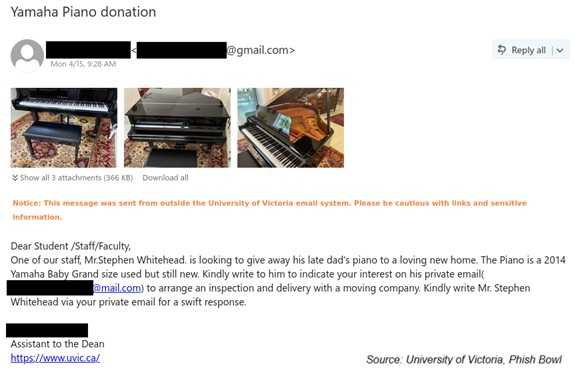
Just when you thought you’d heard it all, there’s always another song to be played. This one is big, very big. It’s called a “Piano Scam”, and countless victims around the globe are getting played. Even those doing everything right to avoid this scam don’t escape it. Here’s why.

This Piano Scam casts a wide net, targeting music schools and music stores, healthcare, and other industries. It also includes individuals searching online for a used piano. A scammer makes an offer that’s hard to refuse, a free piano and a story about why they can’t take it with them. The stories seem credible, often emotional, and include some sense of urgency. These tactics are all highly effective social engineering lures.

A mother looking for a used piano found one listed on Facebook, and it was for free! Someone was moving and didn’t want to take the piano with them. Acting quickly, she did everything a cybersmart user would check, including the freight company. Her search for a scam found nothing to be concerned about and believing it was a legit offer, she went for it. The scammer stole her payment information from her “downpayment” for the shipping cost. With that and her PII, the cyber-creep emptied her financial account.

“Brain Hack”

This elaborate scam is called a “brain hack.” It exploits a victim’s predictable thoughts and moves ahead of time, also called “mirroring authenticity.” It’s social engineering at its best, or worst for its victims. Every little thing a cybersmart user would check to make sure the offer is legit is covered. Scammers set up websites and more to dupe a victim. It’s a highly calculated brain hack not just limited to pianos. They use job offers, cars, products and more, anything to catch a victim. 

The truth is, it could be any one of us caught up in a scam where even careful checking doesn’t expose it. Social engineering red flags and tips help avoid getting deceived. Experts say the first step is slowing down to think before we get caught in a web. Remembering the adage “If something sounds too good to be true it probably is” helps slow us down. As always, common sense is one of the best tools we have keeping us safe online, so don’t be afraid to use it.


Watch Out For Scammers Pretending To Be FDIC Or OIG Officials

Scams & Phishing

Watch Out For Scammers Pretending To Be FDIC Or OIG Officials

Scammers are increasingly pretending to be officials from the Federal Deposit Insurance Corporation (FDIC) or the FDIC Office of Inspector General (OIG). Reaching you by phone, email, text, or even via social media and demanding money or personal information. According to an alert from the FDIC OIG, these impersonation scams often use official-sounding names, real official-looking seals or logos, and urgent or threatening language to seem legitimate. READ FULL STORY

Amazon Text Scam Recalls Your Login Credentials

Mobile Security

Amazon Text Scam Recalls Your Login Credentials

Amazon shoppers are being targeted by a phishing scam posing as a product recall alert. Instead of claiming you'll be charged, the message promises a refund and urges the buyer to click a link to apply to get the money back. However, as you can probably guess, it’s designed to steal your login credentials, which may get the phisher to your payment methods too. Read on to find out how this clever Amazon Recall scam works and what steps to take if you receive one of these messages. READ FULL STORY

AI Generated Fraud Takeover

Your Security

AI Generated Fraud Takeover

As cybercrime is known to do, attacks trend over time, creating new and improved assaults. Fighting back against trending fraud attacks requires everyone, including organization leaders and those overseeing security to be prepared for the latest threats. And with artificial intelligence (AI) now playing a significant role with these crimes, awareness can be an invaluable fraud prevention tool. AI-generated deepfakes make “authorized fraud” a must know of trending crimes. Phishing emails orchestrate 91% of all cyberattacks, with many starting and ending with fraud. READ FULL STORY

Hi, It’s Not Me: It's a 148% Rise in Impersonation Scams

Scams & Phishing

Hi, It’s Not Me: It's a 148% Rise in Impersonation Scams

Impersonation scams have exploded—and we’re not talking about your buddy doing a bad Elvis impression. According to the Identity Theft Resource Center’s latest 2025 Trends in Identity report, these scams have shot up a whopping 148% and are now the most-reported identity crime. The scammers? They’re posing as banks, tech support reps, and even your own family. The scary part? They’re convincing—way too convincing. Sadly, there is no shortage of examples of these. READ FULL STORY

Text Scam Frenzy Explodes Over 300 Percent as Scammers Target Financial Institutions

Mobile Security

Text Scam Frenzy Explodes Over 300 Percent as Scammers Target Financial Institutions

A recent cyber threat snapshot reveals phishing texts posing as various financial institutions have spiked over 340 %, dominating these types of scams in late 2025. These fraudulent messages use fake alerts and deceptive links to steal credentials. Experts warn that as phishing evolves, attackers are playing psychological tricks, not using sophisticated technologies. Learn how scammers are tricking mobile users and simple steps you can take to stay safe in the cyber wild. READ FULL STORY


Close
Fraud News & Alerts!

Keep up with the latest cyber security news through our weekly Fraud News & Alerts updates. Each week you will receive an email containing the latest cyber security news, tips and breach notifications.


You're all set!

You will receive your first official security update email within the next week.

A welcome email has also just been sent to you. If you do not receive this email within the next few minutes, please check your Junk box or spam filter to confirm our emails are not being blocked.


Help  
Enter any word or words you like.        

The email newsletter will arrive from news@stickleyonsecurity.com


Loading
Please wait...