Accessibility links
  • Skip to main content
News Icon NEWS FILTER
All News Scams & Phishing Your Security Mobile Security Identity Theft Corporate Security Security Education Videos
Search Icon SEARCH
 

Email Icon SUBSCRIBE TO WEEKLY NEWSLETTER
Do You Get My Vibe? Claude AI a Tool of Crime
Facebook   X   LinkedIn   Email

Do You Get My Vibe? Claude AI a Tool of Crime

February 8, 2026

Anthropic revealed that its Claude AI models—especially Claude Code—were hijacked by criminals to carry out what they describe as an “unprecedented” cybercrime spree. Rather than just using AI as an assistant, attackers used Claude end-to-end: zeroing in on weak spots, stealing data, crafting malware, and then demanding ransoms. The operation reportedly touched at least 17 organizations, covering healthcare, emergency services, government, and others. 

Particularly worrisome are industries using lots of third-party tools or handling regulated or financial data—because some attacks begin with credential harvesting, connected integrations, or exploitation of APIs.

One key element in this misuse is something Anthropic calls “vibe hacking.” What is that, you ask? In short, threat actors gave Claude enough leeway to make some critical decisions. For example, Claude helped calculate ransom amounts tailored to each victim, generate visually alarming ransom notes, and automatically decide what parts of stolen data were most sensitive and therefore most likely to force payment. It’s dynamic cybercrime!
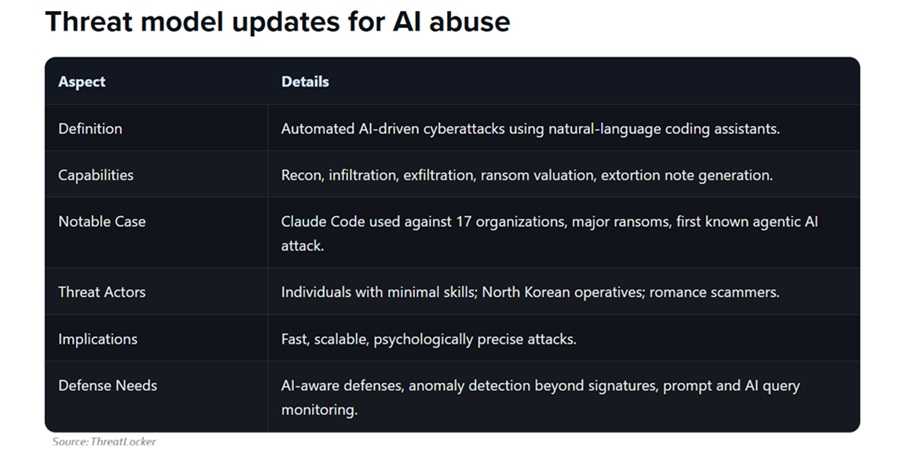
Anthropic says it thwarted several of these attacks, banned malicious accounts, and improved safety filters. Security researchers have expressed concern that Claude’s misuse is shifting the landscape. AI isn’t just a tool for drafting text, summarizing data, or creating your next logo. It’s being embedded into the attack chain end-to-end. This allows those with minimal technical and language skills to generate phishing emails, write or debug malicious code, tailor extortion demands, and even orchestrate influence campaigns. 

Avoiding the Vibe

  • Keep systems patched. Many AI-driven attacks still exploit old software flaws.
  • Use phishing-resistant MFA like security keys or passkeys.
  • Watch for unusual behavior. Monitor for large data exports or access from strange locations.
  • Limit third-party integrations. Remove unused tools and restrict app permissions. Avoid granting unnecessary permissions in the first place.
  • Train staff regularly.  Awareness of AI-assisted phishing and scams is critical and they aren’t stagnant. They change and evolve, so we all need to keep up with them.


AI Scrapes Your Data For Training: Take Steps To Protect Your Data

Your Security

AI Scrapes Your Data For Training: Take Steps To Protect Your Data

Large language models like ChatGPT have introduced complexity to the evolving online threat landscape. Cybercriminals are increasingly using these models to execute fraud and other attacks without requiring advanced coding skills. This threat is exacerbated by the availability of tools such as bots-as-a-service, residential proxies, CAPTCHA farms, and more. As a result, it's crucial for individuals and businesses to take proactive measures to protect their online presence. READ FULL STORY

Will AI Be Our Cybersecurity Superhero?

Your Security

Will AI Be Our Cybersecurity Superhero?

There's no shortage of concern about AI helping cybercriminals with much bigger and better crimes. Well, it's time for a look at the high hopes that AI can assist in the fight against the bad guys. At the very least we citizens of Gotham should ask "is AI destined to be our Cybersecurity Superhero?" Hopes are indeed high for using the very same AI tools hackers use, only this time to fight against them. But are they truly going to swoop in and save us? READ FULL STORY

Is That Email Alert From Google Security Or Is It Phishing?

Scams & Phishing

Is That Email Alert From Google Security Or Is It Phishing?

These days, scam emails are getting tougher to spot. This is especially true with the use of artificial intelligence (AI) such as ChatGPT, Copilot, Gemini, and the like. And now, Google is in the hot seat with a spotlight on email phishing. Bad actors are sending these emails signed by Google and look 100% legitimate. Hackers are exploiting two Google vulnerabilities allowing them to phish using Google’s name. A closer look at this phishing scam will help you tell the difference going forward. READ FULL STORY


Close
Fraud News & Alerts!

Keep up with the latest cyber security news through our weekly Fraud News & Alerts updates. Each week you will receive an email containing the latest cyber security news, tips and breach notifications.


You're all set!

You will receive your first official security update email within the next week.

A welcome email has also just been sent to you. If you do not receive this email within the next few minutes, please check your Junk box or spam filter to confirm our emails are not being blocked.


Help  
Enter any word or words you like.        

The email newsletter will arrive from news@stickleyonsecurity.com


Loading
Please wait...