Accessibility links
  • Skip to main content
News Icon NEWS FILTER
All News Scams & Phishing Security Education Videos Mobile Security Your Security Education Identity Theft Corporate Security
Search Icon SEARCH
 

Email Icon SUBSCRIBE TO WEEKLY NEWSLETTER
Phishing Scam Falsely Claims Google Subpoena Access to Your Email
Facebook   X   LinkedIn   Email

Phishing Scam Falsely Claims Google Subpoena Access to Your Email

October 4, 2025

Google has been in the news a lot lately…and we mean A LOT. We’ve seen browser extension warnings, password recovery warnings, a slick scam that claims to be from Google Technical Support, and several others. Now, a new phishing scam is making the rounds, targeting users with alarming messages that claim Google has received a subpoena to access their email account. It’s getting difficult to keep up with all of these.
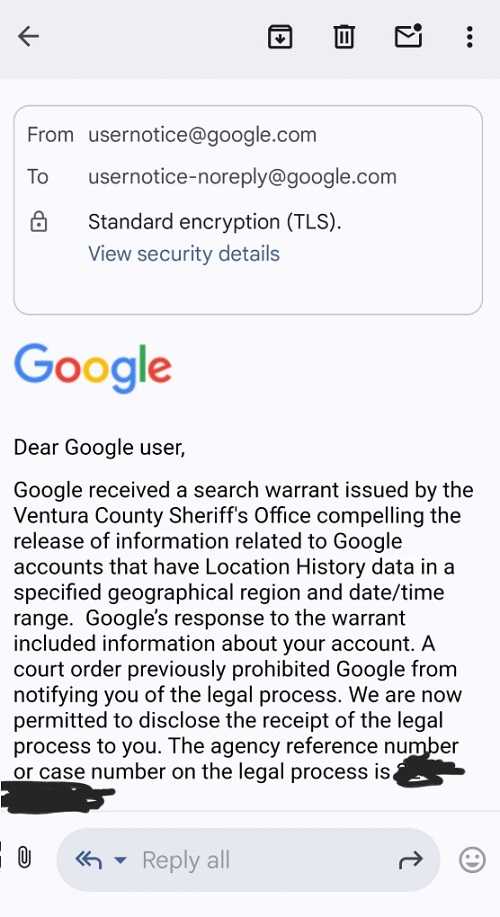
The fraudulent email appears official, using the Google logo and legal language to scare recipients into taking immediate action. Victims are typically urged to click on a link or download a document to "review the subpoena" or "take action" before their account is compromised. This scam uses Google’s own tools to make it even more realistic and to allow the emails to bypass authentication checks and still land in your in box, rather than your spam box.

The attack is designed to steal your personal information, including your email login credentials and other sensitive data. Once credentials are entered into the fake screen, the attackers gain full access to the user’s account. This could lead to identity theft, financial fraud, or the victim’s account being used for further phishing attacks.

Google does not send legal subpoenas to users via email. If you receive such a message, do not click any links, download any files, or reply to the sender. Instead, report the email as phishing through your email provider and delete it immediately. Always verify suspicious messages by going directly to the official website or contacting support through trusted channels.

The good news is that Google is now working on a fix for this after it was reported as a bug by a researcher. Until then, use multifactor authentication on your account and ensure your password is strong. That means using at least eight characters that is not easy to guess. As always, stay cautious—when in doubt, don’t click.


Phone Scammers Use Big Tech As Lures

Mobile Security

Phone Scammers Use Big Tech As Lures

Ask a robocall recipient and they’ll tell you that robocalls are annoying and a waste of time. But the victim of a phone scam (vishing) will tell you it could mean losing a lot more than just time. Like email phishing, falling for a vishing scam can put you in danger of losing your identity, your money, and any other private information a criminal can get. So, what to do when the caller claims to be from a trusted business and has a legitimate reason to call? READ FULL STORY

Ways To See If Your Data Has Been Stolen

Education

Ways To See If Your Data Has Been Stolen

With all the data breaches, whether by intrusion or accident lately, it’s likely your information was exposed somehow to someone you didn’t intend. After all, the marketing company Exactis, exposed hundreds of traits on us in 350 million records. Yahoo let out email addresses and passwords on billions of people, and of course who can forget the massive breach of Equifax just last year. There is a lot of information that gets leaked on us and the more the bad actors have on us, the more targeted their phishing campaigns can be. Checking on whether or not your data is available in the underground can help you mitigate any fraud or identity theft. READ FULL STORY

Agencies Warning Gmail, Outlook, and Apple Mail Users of Fire-Related Scams

Scams & Phishing

Agencies Warning Gmail, Outlook, and Apple Mail Users of Fire-Related Scams

As with all catastrophes and other disasters and big events, scammers seem to come out of the ashes to take advantage of empathizers among us. In the aftermath of the recent California wildfires, cybercriminals are exploiting the situation to target users of Apple Mail, Gmail, and Outlook with sophisticated scams. These malicious actors are leveraging the urgency and emotional impact of the disaster to deceive well-intentioned individuals. READ FULL STORY

Gmail Tech Support Exposes New Threats From AI

Your Security

Gmail Tech Support Exposes New Threats From AI

A significant cybersecurity breach involving Gmail raised alarms across the tech community late in 2024. Hackers leveraged advanced AI techniques to create a sophisticated scheme involving account recovery phishing emails that were nearly indistinguishable from legitimate communications. And, to make it even more believable, they were followed up with a phone call from a “Gmail tech support person,” throwing everyone a phishing curveball. READ FULL STORY

The Most Hacked Apps To Get To Your Details

Mobile Security

The Most Hacked Apps To Get To Your Details

We share a lot these days. Some might even say we spout personal details like a water from a fire hydrant, especially when it comes to social media. For hackers, that means they have us all right where they want us. Researchers at TechShielder put in some work and found that there are a number of apps available to us that actually have been repeatedly compromised and share our personal information with plenty of others that we may not want to have our information. READ FULL STORY


Close
Fraud News & Alerts!

Keep up with the latest cyber security news through our weekly Fraud News & Alerts updates. Each week you will receive an email containing the latest cyber security news, tips and breach notifications.


You're all set!

You will receive your first official security update email within the next week.

A welcome email has also just been sent to you. If you do not receive this email within the next few minutes, please check your Junk box or spam filter to confirm our emails are not being blocked.


Help  
Enter any word or words you like.        

The email newsletter will arrive from news@stickleyonsecurity.com


Loading
Please wait...