Accessibility links
  • Skip to main content
News Icon NEWS FILTER
All News Scams & Phishing Security Education Videos Mobile Security Your Security Education Identity Theft Corporate Security
Search Icon SEARCH
 

Email Icon SUBSCRIBE TO WEEKLY NEWSLETTER
Hi, It’s Not Me: It's a 148% Rise in Impersonation Scams
Facebook   X   LinkedIn   Email

Hi, It’s Not Me: It's a 148% Rise in Impersonation Scams

September 3, 2025

Impersonation scams have exploded—and we’re not talking about your buddy doing a bad Elvis impression. According to the Identity Theft Resource Center’s latest 2025 Trends in Identity report, these scams have shot up a whopping 148% and are now the most-reported identity crime. The scammers? They’re posing as banks, tech support reps, and even your own family. The scary part? They’re convincing—way too convincing.

There is no shortage of examples of these, but here are a couple.

In one currently circulating scam, crooks send texts claiming to be from Amazon, warning you that someone’s placed a suspicious charge on your account. You panic, tap the link, and BAM—they’ve got your login credentials, your payment info, and maybe even remote access to your device if you follow all the fake “security steps.”
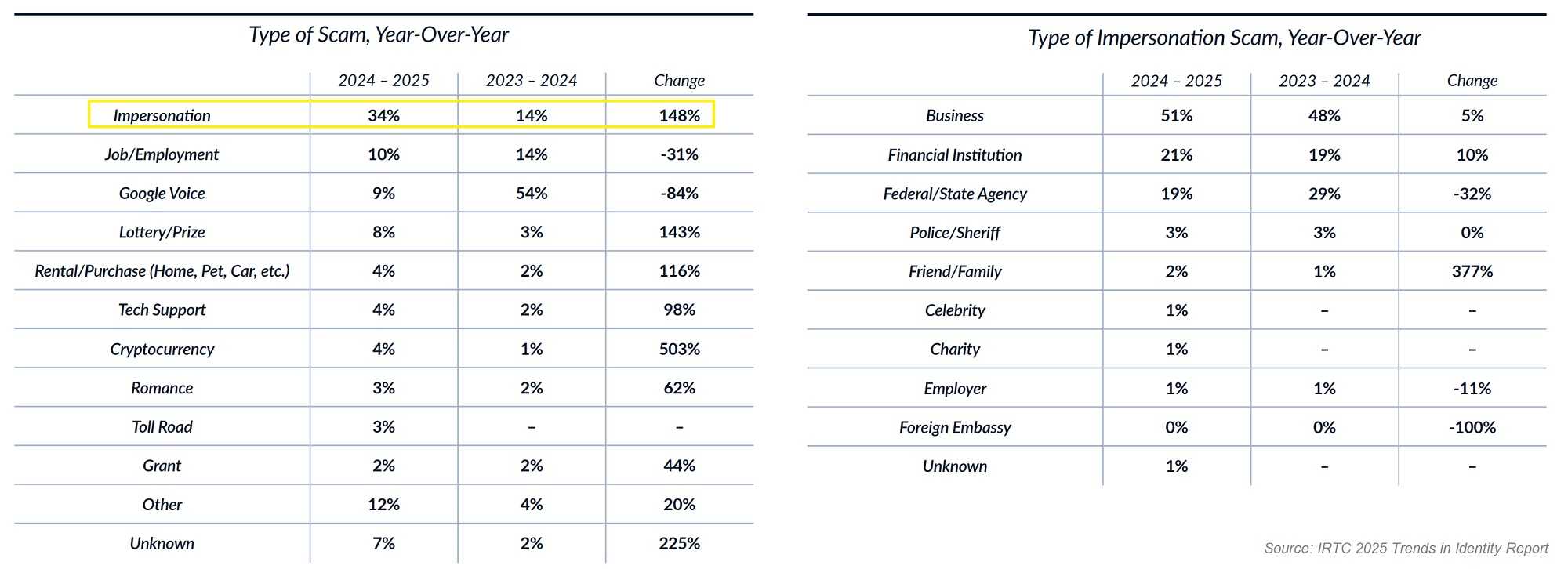
Then there’s the government impersonation twist: you get a call from someone claiming to be from the Social Security Administration, saying your number has been “linked to criminal activity.” They tell you to verify your identity—just a little birthday and SSN “for security.” And just like that, they’ve got the keys to your identity.

Impersonation scams work because they hit you where it hurts—your money, your fear, your sense of trust. And thanks to AI, these fakes are sounding smoother than ever.

Tips to thwart the impersonators:

  • Never click a link from a text unless you were expecting it—and even then, double-check.
  • No legitimate agency will ever ask for your full SSN, bank login, or password by phone.
  • Hang up. Call back using the official number—not the one they give you.
  • If you’re made to feel rushed into a choice or the offer sounds too good to be true, you can bet it’s a scam.

Bottom line? If someone claims to be someone you trust… verify before you comply


Phishing Scam Falsely Claims Google Subpoena Access to Your Email

Scams & Phishing

Phishing Scam Falsely Claims Google Subpoena Access to Your Email

Google has been in the news a lot lately…and we mean A LOT. We’ve seen browser extension warnings, password recovery warnings, a slick scam that claims to be from Google Technical Support, and several others. Now, a new phishing scam is making the rounds, targeting users with alarming messages that claim Google has received a subpoena to access their email account. It’s getting difficult to keep up with all of these. This scam uses Google’s own tools to make it even more realistic and to allow the emails to bypass authentication checks and still land in your in box, rather than your spam box. READ FULL STORY

Meerkats Shapeshift to Steal Logins

Scams & Phishing

Meerkats Shapeshift to Steal Logins

Morphing Meerkat is a recently identified phishing-as-a-service (PhaaS) platform that employs advanced techniques to deceive users and steal credentials. Discovered by cybersecurity firm Infoblox, this platform exploits Domain Name System (DNS) mail exchange (MX) records to dynamically generate fake login pages, impersonating over 100 brands, including Gmail, Outlook, AOL, Office 365, and Yahoo. The attack initiates when a victim clicks on a malicious link embedded in a phishing email. READ FULL STORY

AI Generated Fraud Takeover

Your Security

AI Generated Fraud Takeover

As cybercrime is known to do, attacks trend over time, creating new and improved assaults. Fighting back against trending fraud attacks requires everyone, including organization leaders and those overseeing security to be prepared for the latest threats. And with artificial intelligence (AI) now playing a significant role with these crimes, awareness can be an invaluable fraud prevention tool. AI-generated deepfakes make “authorized fraud” a must know of trending crimes. Phishing emails orchestrate 91% of all cyberattacks, with many starting and ending with fraud. READ FULL STORY

Executive Impersonations Lead to $2.7 Billion in Costs To Businesses

Corporate Security

Executive Impersonations Lead to $2.7 Billion in Costs To Businesses

Executive impersonation attacks, also known as CEO fraud or whaling attacks, are a type of phishing attack where attackers pose as a high-level executive, such as a CEO, CFO, or other C-Level, in order to trick employees into revealing sensitive information or transferring money. Essentially, these are other ways attackers use Business Email Compromise (BEC) attacks. Executive impersonation attacks can be very costly for businesses. In 2022, the FBI's Internet Crime Report found that these types of attacks cost businesses over $2.7 billion. READ FULL STORY

What You See Is Not What You Get; Phishing Attack Skips Email Security Measures

Scams & Phishing

What You See Is Not What You Get; Phishing Attack Skips Email Security Measures

It’s no surprise that phishing is still prevalent in the cyber world. In fact, it remains the top way malware gets onto devices, and it still excels at getting people to give up their personal information. Phishing scams, and they are aplenty, aim to deceive individuals into divulging sensitive information such as passwords, payment card details, or all other kinds of personal data; some that you don’t even think is all that useful to someone trying to scam you. READ FULL STORY


Close
Fraud News & Alerts!

Keep up with the latest cyber security news through our weekly Fraud News & Alerts updates. Each week you will receive an email containing the latest cyber security news, tips and breach notifications.


You're all set!

You will receive your first official security update email within the next week.

A welcome email has also just been sent to you. If you do not receive this email within the next few minutes, please check your Junk box or spam filter to confirm our emails are not being blocked.


Help  
Enter any word or words you like.        

The email newsletter will arrive from news@stickleyonsecurity.com


Loading
Please wait...