Accessibility links
  • Skip to main content
News Icon NEWS FILTER
All News Scams & Phishing Security Education Videos Mobile Security Your Security Education Identity Theft Corporate Security
Search Icon SEARCH
 

Email Icon SUBSCRIBE TO WEEKLY NEWSLETTER
Can Using The Same Password Lead To A Stolen Car?
Facebook   X   LinkedIn   Email

Can Using The Same Password Lead To A Stolen Car?

January 2, 2026

In an age where cybercrime is increasingly sophisticated, it’s no surprise that criminals are using open-source tools to automate the process of cracking online accounts. This is especially true when it comes to mass password cracking or credential stuffing. This dangerous trend has allowed cybercriminals to make a lot of money with very little time or effort. They can deploy bots designed for data scraping and executing credential stuffing attacks on various websites and mobile apps. Their secret weapon? Exploiting the widespread tendency of users to reuse credentials across multiple sites.

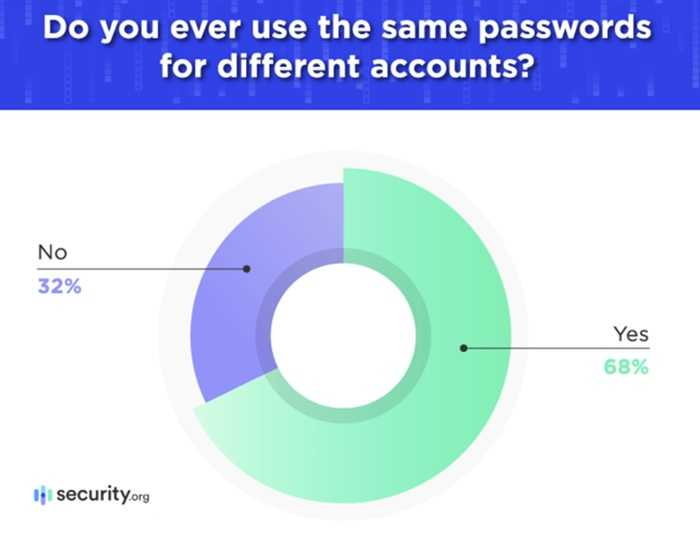
According to a 2025 survey by security.org, 68% of people still use the same password in multiple accounts. Recent attacks demonstrate why it shouldn’t be done. One in particular might surprise you.
Cybercriminals have begun shifting their focus to a rather unexpected target; one you may not think has any real risk – your vehicle information. Within one week, Kasada Threat Research found that there were 10,000 stolen auto accounts available on underground marketplaces; the next week they found an additional 5,000. These sold for a mere $2 each. Now, the question that naturally arises is: What could criminals possibly do with this vehicle information? Well, they can do a lot including:

  • Clone your car
  • Register your vehicle under their name
  • Use information gained from the VIN to rob your residence
  • Steal your identity
  • Commit loan fraud
  • Perform targeted phishing attacks against you
As we know, any platform relying on user accounts and passwords is susceptible to these threats. To protect data from threats like this, consider the following:

  • Use complex and unique passwords for each online account, no matter how unimportant you think the information in them may be.
  • Keep an eye on your accounts for signs of ATOs and unusual login activity to identify compromised accounts early.
  • Enable multi-factor authentication (MFA) to enhance security by making it significantly harder for attackers to gain unauthorized access. Remember to do this on your vehicle’s online accounts. There’s a lot of information in those.
  • Always be on the lookout for phishing attacks. The more information someone has on you, the more specific they can be. If you’re not expecting a link, don’t click it.

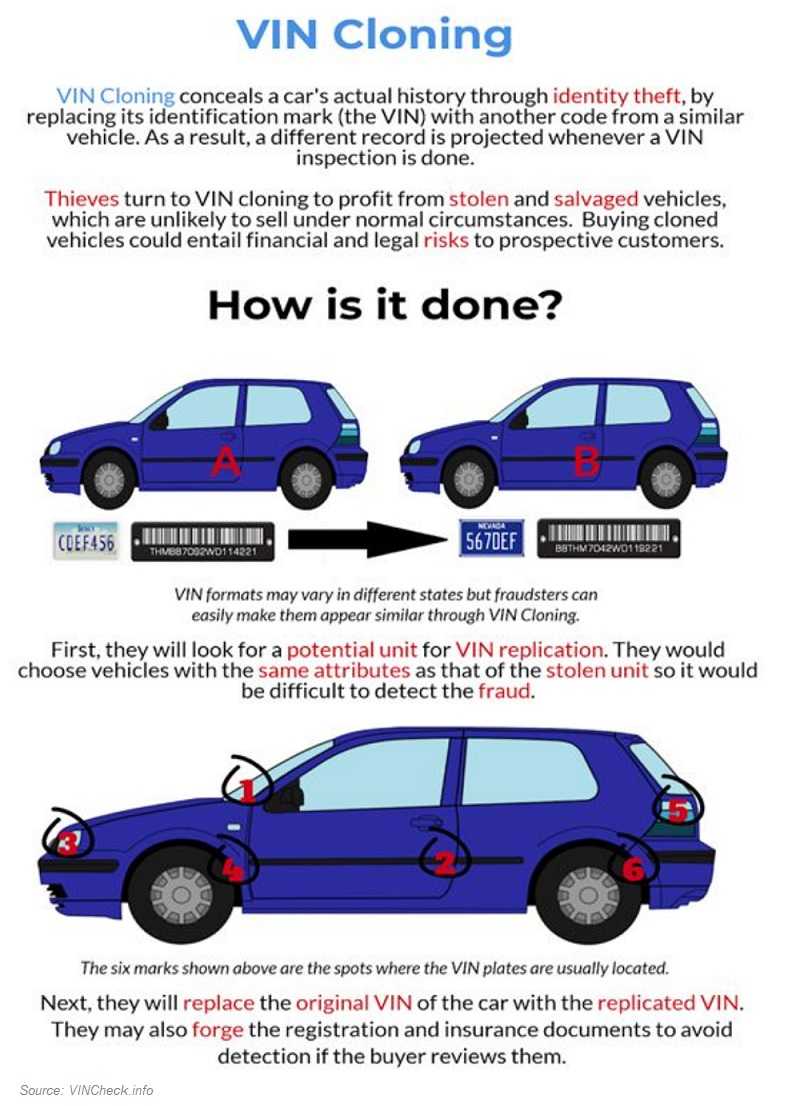
In 2017, a database was left open and unsecured for months. That database contained more than 10 million VIN numbers for vehicles from numerous manufacturers. There are numerous reports online about people who have been victims of VIN cloning. The FBI briefly outlined how it works.

  • After stealing a car, thieves take off to a neighboring state. They find a large car dealership and look for a vehicle that’s the exact make, model, and color of the stolen one.
  • They write down VIN stamped on the top of the dashboard and drive off.
  • They make an exact replica of the new VIN tag and replace the legitimate one on the stolen vehicle.
  • Finally, the thieves forge information to get a real title or other ownership documents from the DMV in the other state.

At this point, it’s not hard to sell the vehicle because it’s legally registered and not reported as stolen. And if you happen to buy one of them, it can be a big problem for you.


Financial Services Robust Security Forces Cybercriminals To Target Customers

Your Security

Financial Services Robust Security Forces Cybercriminals To Target Customers

Cybersecurity experts are focused on finding ways to foil attempts by cyber criminals to access information related to client accounts and the cyber criminals themselves, who are continually in search of loopholes in security solutions to access sensitive personal information. And if research from Akamai is true in their annual “State of the Internet” report, then cybersecurity teams are fighting a desperate fight against professional malware groups intent on using a variety of tactics. READ FULL STORY

Credential Stuffers Compromise More Than 100K Accounts

Your Security

Credential Stuffers Compromise More Than 100K Accounts

Credential stuffing is a cyber-attack in which stolen user credentials and corresponding passwords are used with brute force to make automated login requests. The stolen user credentials are typically from data breaches that could have happened recently, but also may have occurred long ago. These types of attacks are particularly effective when the same username and password combination is used across multiple websites or services. New York’s attorney general announced that an investigation into credential stuffing had uncovered 1.1 million compromised customer accounts linked to 17 well-known companies. READ FULL STORY

Creative Hacking Underscores The Need For MFA

Your Security

Creative Hacking Underscores The Need For MFA

Attackers are getting more creative by the day. It's more important than ever before with so many bad actors out there to make all of your accounts ultra-secure. That means that using some method of multifactor authentication (MFA) is in order. Case in point: Recently, there was an elaborate scheme targeting unsuspecting users that would perhaps not have been victims, had MFA been enabled. The attackers sent spam email promoting fake sweepstakes where recipients were encouraged to put their credentials into a form. READ FULL STORY

Shut The Door! Don't Leave Your Network Open To Account Takeovers

Corporate Security

Shut The Door! Don't Leave Your Network Open To Account Takeovers

If your company is like most, it has seventeen sets of login credentials floating around online. According to a study by Arctic Wolf, those credentials exposed in data breaches or other cybercrimes are always welcome on the dark web. They’re typically for sale, but often offered for free, and anyone interested in using them has a digital buffet of login data at their disposal. Arctic Wolf’s report, “2020 Security Operations” sheds light on account takeovers and how easily they can be launched. READ FULL STORY


Close
Fraud News & Alerts!

Keep up with the latest cyber security news through our weekly Fraud News & Alerts updates. Each week you will receive an email containing the latest cyber security news, tips and breach notifications.


You're all set!

You will receive your first official security update email within the next week.

A welcome email has also just been sent to you. If you do not receive this email within the next few minutes, please check your Junk box or spam filter to confirm our emails are not being blocked.


Help  
Enter any word or words you like.        

The email newsletter will arrive from news@stickleyonsecurity.com


Loading
Please wait...