Accessibility links
  • Skip to main content
News Icon NEWS FILTER
All News Scams & Phishing Security Education Videos Mobile Security Your Security Education Identity Theft Corporate Security
Search Icon SEARCH
 

Email Icon SUBSCRIBE TO WEEKLY NEWSLETTER
DMV Warns of Scammers Driving Off with Your Info
Facebook   X   LinkedIn   Email

DMV Warns of Scammers Driving Off with Your Info

July 26, 2025

The California DMV has issued a warning to drivers about a new scam circulating on social media. Fraudsters are creating fake advertisements that claim to offer vehicle registration renewal at a too good to be true 50% discount, offering an appealing alternative to the official fee, which truly can make one’s head spin faster than a racecar’s wheels off the starting line. It’s not limited to California, however. Other DMVs have put out the warning flag as well.
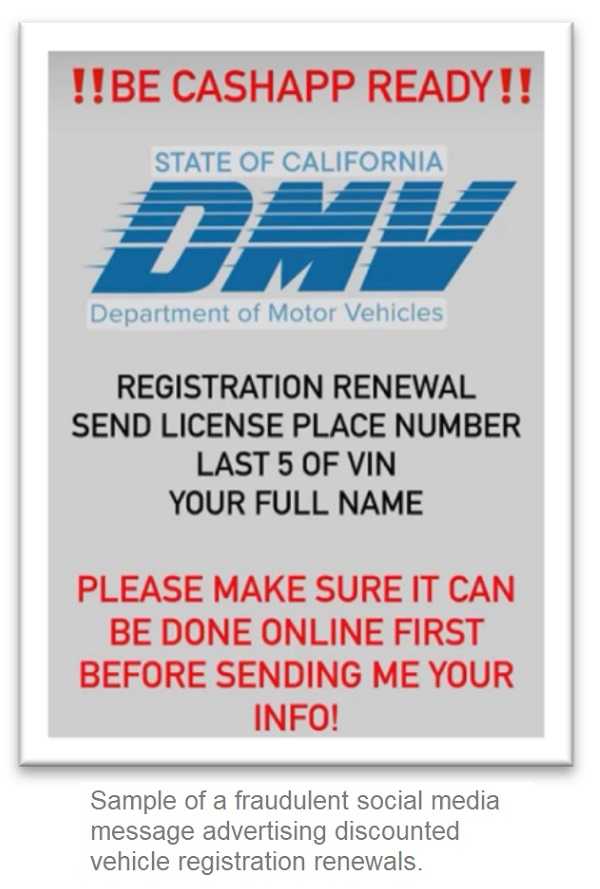
Scammers post ads—often on Facebook, Instagram, or Twitter—claiming to help with DMV registration for half the cost. Interested users are asked to provide their license plate number, vehicle ID number, and full name. For convenience, they can even pay via Cash App, Venmo, or similar services. The payment pages mimic official layouts but are controlled by criminals.

These ads circulate widely on social media platforms and often look polished and official, but the DMV strictly prohibits offering discounts and never processes payments through third-party apps or social media channels.

How to avoid having scammers drive off with your data

  • Use only official DMV channels: Complete renewal payments via the California DMV website or authorized Business Partner Automation Program businesses. There’s a list on the CA DMV website.
  • Never pay through peer-to-peer apps like Cash App, Venmo, or PayPal for DMV fees.
  • Verify any offer by calling the DMV at the number on their website or by visiting the official site. Don’t click links in the ads or in any text you may receive.
  • Ignore unsolicited links or texts promising deals or discounts. The DMV does not advertise via social media or third-party platforms.
  • Report suspicious content found online to both the DMV and the platform hosting the ad.

Beautifully convincing though they may appear, these “discounted registration” posts are elaborate scams aimed at stealing your money and personal data. Stick to official DMV methods—online, kiosks, or in-person at the DMV offices or a partner location—and keep your eyes on the road to avoid falling prey.


Can Using The Same Password Lead To A Stolen Car?

Your Security

Can Using The Same Password Lead To A Stolen Car?

In an age where cybercrime is increasingly sophisticated, it’s no surprise that criminals are using open-source tools to automate the process of cracking online accounts. This is especially true when it comes to mass password cracking or credential stuffing. This dangerous trend has allowed cybercriminals to make a lot of money with very little time or effort. This time, they're going after something you may not expect from cybercriminals...your vehicle! READ FULL STORY

Unpaid Toll Scam Drives Us All Crazy

Scams & Phishing

Unpaid Toll Scam Drives Us All Crazy

Have you taken a toll road recently? Well, even if you haven’t, this story is for you. There is a text message going around that anyone who drives on highways or freeways should be on the lookout for and it’s just annoying enough to drive anyone mad. As you can guess, it involves driving (or perhaps not driving) toll roads and the supposed accompanying fees related to them, as well as fake websites, the attempted collection of information, and other phishing flags. READ FULL STORY

Senior Scams—When Elder Fraud Gets Personal

Scams & Phishing

Senior Scams—When Elder Fraud Gets Personal

Last year in the U.S., nearly two-thirds of scam victims were seniors. Whether family, friend or neighbor, many of us know a senior citizen. But one thing many of us don’t know is how vulnerable they are to cybercrime. The FBI reports those aged 60+ are potential victims of a nearly $3.5 billion criminal scheme to defraud this at-risk group, and it’s only getting worse. The reasons behind the attacks are simple. It's about money and trust. READ FULL STORY

Is Sideloading Worth The Risk Of Downloading Malware?

Your Security

Is Sideloading Worth The Risk Of Downloading Malware?

It’s been well-known that sideloading apps is a risky proposition. Just ask the 20 million Aptoide users who recently learned their personally identifiable information (PII) was posted online by a hacker. Aptoide, a popular third-party app “discovery platform” had its database hacked earlier this month. The cybercriminal behind the hack claims that in addition to the 20 million exposed data files, there’s an additional 19 million files in their possession. Whether that’s true or not remains a mystery for now, but the Aptoide incident shows (in a huge way) why app sideloading is risky at best and is not recommended by security professionals. READ FULL STORY

Mazda Infotainment Software Drives Hacks

Your Security

Mazda Infotainment Software Drives Hacks

Most drivers love their infotainment systems. The truckload of functions they provide can make trips both long and short easier and more fun to do. But what happens when the software running the infotainment system is hackable? Owners of certain Mazda’s are finding that out—some before and some after it’s too late. Multiple security vulnerabilities are exploited in this hack. The flaws are specifically found in the Connectivity Master Unit, or CMU. READ FULL STORY


Close
Fraud News & Alerts!

Keep up with the latest cyber security news through our weekly Fraud News & Alerts updates. Each week you will receive an email containing the latest cyber security news, tips and breach notifications.


You're all set!

You will receive your first official security update email within the next week.

A welcome email has also just been sent to you. If you do not receive this email within the next few minutes, please check your Junk box or spam filter to confirm our emails are not being blocked.


Help  
Enter any word or words you like.        

The email newsletter will arrive from news@stickleyonsecurity.com


Loading
Please wait...